
Building a Single Garage for a Grade II Listed Building
Most outbuildings such as garden offices, garden sheds and garages do not need planning permission so long as it is built on your own land and comply with the regulations below:
- Outbuildings and garages to be single storey with maximum eaves height of 2.5 metres and maximum overall height of four metres with a dual pitched roof or three metres for any other roof.
- Maximum height of 2.5 metres in the case of a building, enclosure or container within two metres of a boundary of the curtilage of the dwelling house.
- No verandas, balconies or raised platforms (a platform must not exceed 0.3 metres in height)
- No more than half the area of land around the “original house” would be covered by additions or other buildings.
- No outbuilding on land forward of a wall forming the principal elevation.
- On designated land* buildings, enclosures, containers and pools at the side of properties will require planning permission.
A notable exception to the above information, is when you wish to build an additional building within the grounds of a Listed Building. What is not well known is that everything within the grounds of a Listed Building is listed, not just the house/wall/structure which is of historical interest. So whatever you build becomes part of the listed building in the future and therefore needs planning permission.
At Greater Cambridge Construction we were given the job of building a large single garage at a Grade II Listed Building in a village North of Cambridge. This area has a number challenges due to it being a conservation area with a plethora of Listed Buildings all along the High Street. Like several areas in Cambridge, it also has a high water table so deep foundations are not an option otherwise you just hit water.
Planning Permission
The customer had decided that they wanted a single garage built at the end of an existing driveway, however the unusual shape of the garden meant that the garage could not be built as a continuation of the driveway because the footprint of the building tapered inwards, so the garage could not be built squarely with the drive and had to be angled in a way that followed the perimeter of the boundary wall. However the new garage also had to allow sufficient space for a reasonable sized vehicle to drive into the garage.
The customer had already submitted plans to the Planning Department and had them rejected. This is an expensive exercise because Cambridge Council no longer has a policy of free of charge resubmissions. Although planning office say they are happy with sketches showing the basic concept being proposed, the reality is that they require information and detail that the average home owner is not aware of and unless this information is provided within the timescale specified by the planning department, the application is rejected, which is what happened in this case.
We therefore recommended that our customers use Greater Cambridge Construction’s, Design and Build Service where we introduce the customer to a very experienced architect and a structural engineer, who charge a reasonable price and produce drawings and calculations acceptable to both the planning department and building control.
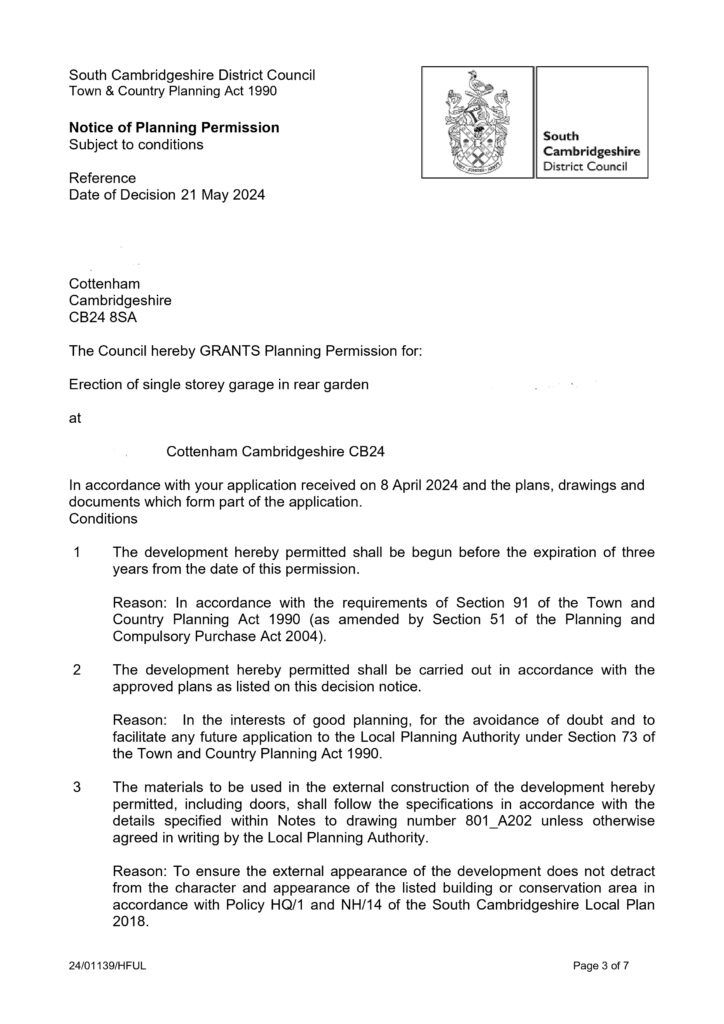
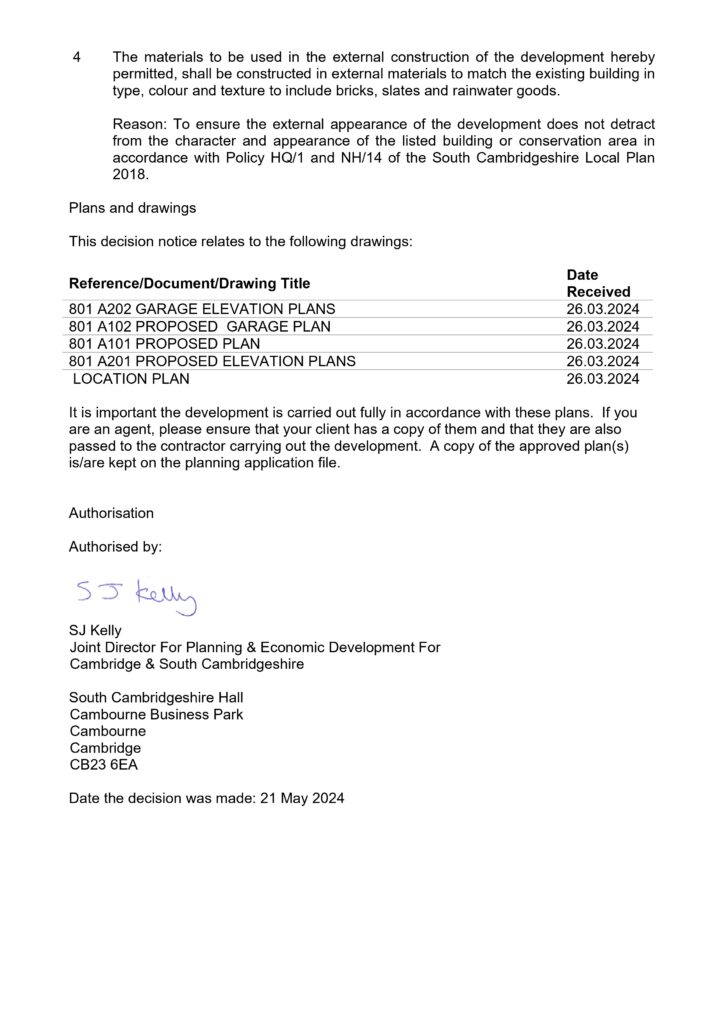
The architect we work with appreciated the issues which had confounded the original planning application and produced drawings and a specification which ticked all of the boxes and the plans were passed.
Cost of planning application £258
Cost of architects drawings £900
Heritage Statement
This is something that can be unexpected but the Heritage statement is required for a planning application for a Listed Building which assesses the significance of listed building (the heritage asset) and the potential impact of your plans to develop it. It includes a description of the property’s history, character, and significance, followed by a detailed summary of how the proposed building work will affect it.
Greater Cambridge Construction can provide examples of Heritage Statements and can complete this for you, although they are often written by the owners of the listed building as they know the house best and also the area in which they live.
The Heritage statement is not a lengthy tome, but it is very important to your planning application.
Risk averse?
A full risk assessment is necessary to minimise the likelihood of any accidents. They may seem bureaucratic, but it helps focus everyone’s mind on potential problems and how to avoid them. Nothing can be considered ‘routine’, there is always something to worry about. In this case one of the main concerns was the overhead cables when unloading trucks using a crane.
Structural Engineering
Getting planning permission does not mean that spades can immediately go into the ground. Planning permission is the beginning of the process and the next step is to produce plans for the foundations of the garage and this requires a structural engineer.
A structural engineer has an incredibly responsible job. He must examine the ground, assess things like the water table, soil type and even nearby trees to produce a design for the foundations which will pass the test of time and also give building control a specification to refer to, so they ensure that what is being built, meets the engineers design. So called “Compliance to design”.
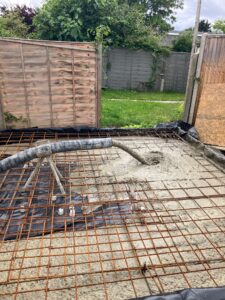
Greater Cambridge Construction works closely with a structural engineer who produced designs for the foundations and steelwork which proved practical, reliable and safe in practice. The engineer first visited the property and established that traditional slit foundations would not be practical because of the high water table. Instead he designed a raft foundation, made with reinforced concrete i.e. concrete poured over a steel network which adds strength to the concrete and minimises the possibility of cracking in time.
Boundary Wall permission
When a building is being built on the boundary, it becomes a boundary wall. There is a lot of legal hoops to jump through regarding boundary walls, but these can be circumvented by obtaining permission from your neighbour, in writing, to say that they are happy with the wall of your building becoming the boundary between the two properties.
An immediate advantage of a solid brick dividing wall is increased privacy and soundproofing, but also if this replaces a fence, the fence no longer needs to be maintained, because it is replaced by the wall of the garage. In this project, the fence belonged to the neighbour and they were happy for this to be removed and replaced by the garage wall.
In all cases, it pays dividends to speak with your neighbours about your proposed garage or extension before planning permission is submitted and keep your neighbours informed at each step of the way as to when work is going to start and any major items which might affect them eg pouring concrete, building the boundary brickwork or fitting the roof. In some cases it will be necessary for tradesmen to work in your neighbour’s garden in which case a good relationship is advisable.
As a gesture of goodwill the customer asked us to retain the best panels and replace any worn panels in the boundary fence including buying some new panels. The benefit of maintaining good relations with neighbours cannot be understated.
The first day onwards
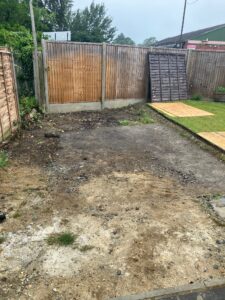
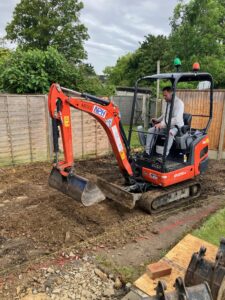
Safety concerns and risk assessments are made, diggers ordered and the site created. The foundations were marked out as per the planning design and dug out as per the design from the structural engineer. Foundations have to be dug until you hit clay to avoid movement and for a raft design, the foundations are dug like a square polo mint, with a raised area remaining in the centre.
Reinforced steel bars are then skilfully laid in the foundations and knitted together with steel wire so they remain taut and will not deform when tons of concrete are poured over it. But… back up the truck, because there is one very important point, which cannot be missed. The foundations and reinforcements must be inspected by a Building Inspector and passed as adequate before a single drop of concrete can be poured.
Greater Cambridge Construction Limited employed RH Building Control in Waterbeach for this construction, and their lead inspector, Duncan Hones was consistently thorough but helpful, and RH passed the first stage of the construction and things were starting to take shape.
Are Friends Electric
You do not want to be installing electricity retrospectively! The electricity supply must be designed into the construction and very importantly, the main supply cable must be securely fixed in place before pouring the concrete or it will be lost forever if it comes loose.
The customer wanted lights and double sockets for battery chargers etc. and therefore the correct specification of armoured cable was laid through the foundations so it emerged in the correct place to connect it to the wall mounted consumer unit (fuse box). Greater Cambridge Construction took a lot of time to ensure this crucial cable was in the correct place so it would be located neatly against the inside wall (as soon as we had one). We also secured it carefully to a vertical steel to make sure it stayed in place. The cable was to be buried under a block paved patio and run underground alongside the house (at a minimum depth of 450mm and would be connected to the mains supply once the garage was complete.
Is it Set in Stone?
It is quite a milestone when the concrete mixer arrives and the hole in the ground becomes the basis for the newly created garage.
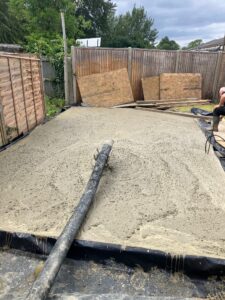
There are a number of suppliers of concrete in Cambridge area, Cardinalis, Mick George and Madingley Mulch to name three, in this case we elected for Madingley Mulch. Like everything else, ordering concrete is not necessarily straightforward, for a start it has to get from the concrete mixer into the foundation. If the concrete mixer cannot pour straight into the pit, then it needs to be pumped, this is an extra expense because the pumping company has to booked separately and paid separately. Some companies such as Cardinalis (who we have also used), are able to provide trucks that deliver concrete and pump it and you only pay for the amount used. This can save you money in the long run particularly if the concrete supplier delivers a fixed amount of concrete (which is sold by the cubic metre) and if you have too little that is a real problem so you over order. Some concrete companies insist upon delivering the full amount, which leaves a problem about how to get rid of the excess. Fortunately in this case, we had already anticipated an excess and used this as a foundation for small block paved patio at the rear of the garage, which the customer had already planned.
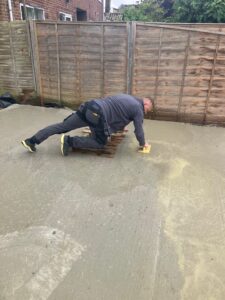
The surface is then flattened as soon as possible the next day and kept damp to avoid it drying out too quickly. This is very important to avoid cracks or surface cracking in the future.
Engineering Bricks
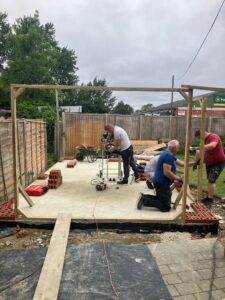
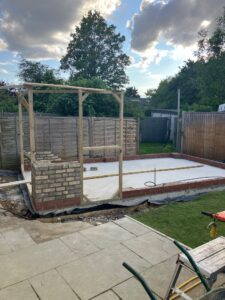
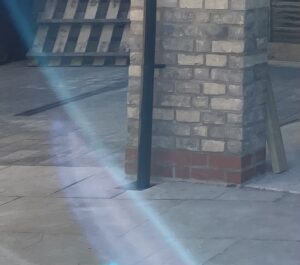
The bricklayer then lays two or three courses of engineering bricks. Engineering bricks have high strength under compression and low water absorption. Their purpose of these is to provide structural support for the weight of the building.
It is vitally important at this stage to have measured the area of the bricks accurately as everything depends upon this including the location of the main door to the garage, the side door and the roof trusses. The architects drawings will have already specified the sizes of the doors.
Choice of bricks
There are endless choices of bricks to choose from, but when building a garage for a Listed Building, the colour and type of the brick must match the house as near as possible. If you want a contrasting brick, this has to be approved by the planning department.
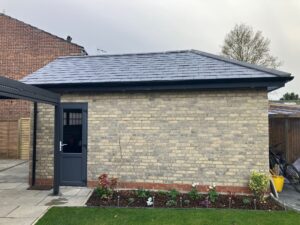
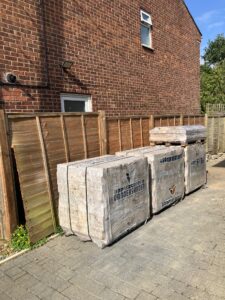
In this case the house in question had been altered, had doorways bricked up, windows created and no doubt extended numerous times during its 300 year history, so it had 300 years of different bricks ranging from what looked like Cottenham Whites (no longer made) to Cambridge Whites (still available) to pink and even some black faced bricks. Getting an exact match was impossible because you cannot exactly match many different styles and shades of bricks with one brick. Instead the customer chose a Vandersanden Cambridge Cream (dark weathered) brick available from both Travis Perkins and Ridgeons which was also used on the front garden wall and was a very good ‘fit’ overall, without being an exact match.
Our highly skilled bricklayer, already in his 7th decade with many years of experience behind him was able to match the style of the bricklaying used for the original house extremely well, with three sizes of bricks created which matched the house perfectly. The customer was very pleased.
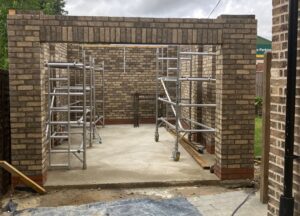
It was already decided that the garage would be single skinned to maximise the internal dimensions, so piers were necessary inside, particularly in the vulnerable L shaped wall between the two doors. These were strengthened to ensure the garage would stand up to whatever winds and other hazards Cambridgeshire could throw at it. The Building Inspector had expressed that this was an area he wanted to see as ‘belt and braces’ and he was happy with the result.
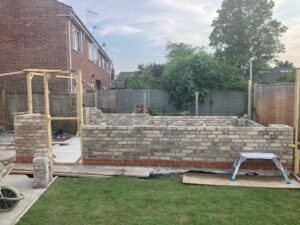
Even though we have an experienced building team, it is always a seminal moment when you see the new building rising from nothing, beginning with the corners and filling the areas in between having carefully installed the damp proof membrane. At the end of the day, you are creating a structure which may outlive us and becomes part of the history of this Grade II Listed building. On the other hand the next owners may decide to demolish it……who knows?
Like a phoenix rising from the ashes the garage begins to rise, transforming the derelict land where it used to stand into a meaningful shape. Our bricklayer, takes a real pride in his work and his skill in reproducing the style of the main building is a thing of legends
What a steel!
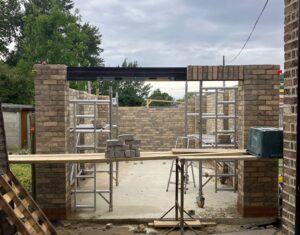
As the height rises you reach the point at which the plans say you have to install lintels above the side door and main garage door with a soldier course of bricks above to finish off the doorway neatly. This was a large single garage with one side door, so it did not require a bespoke lintel and it was only carrying the weight of the gable end bricks and part of the roof rather than an entire storey of a house like a structural wall lintel. A steel lintel was therefore installed above the main door and a concrete lintel above the side door. The garage was now really taking shape and passed second inspection by the building inspector.
Once at its full height timber wallplates are fitted along the top of the wall to facilitate fitting the roof trusses and held down with ‘holding down’ retaining straps.
Keeping a roof over your head
As stated above, in a Grade II Listed building the garage has to be in-keeping with the main house, so the roof had to be built to match the roof of the main house. This was slate, so the garage roof also had to be a matching slate. Fortunately a good match was found at a nearby roofing supplier and purchased.
In the meantime the roofing trusses were ordered from Travis Perkins. Although these were specified in the plans, it is always necessary to ensure that what is actually built is within acceptable tolerances before discovering the trusses are too big or too small. There was no need to worry because our bricklayer’s walls were beautifully straight and the trusses were ordered for delivery. We did consider manufacturing the trusses ourselves, but in the end decided to order them from the local Norfolk based manufacturer, Crenden, who delivered the correct trusses on time.
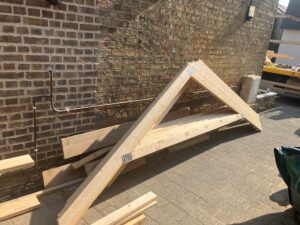
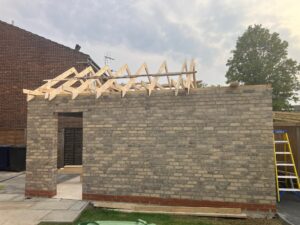
Trusses were then hoisted into place and our carpenters worked tirelessly to convert these large triangular timers into the framework for the roof, with the building inspectors again being satisfied with their labours.
People just look at a roof and accept that it looks nice, but considering the angles of the pitch and the hip at the rear and the three dimensions and different angle the ridging tiles are required to lie, it is a testament to the skill of the roofers that this is so effectively achieved.
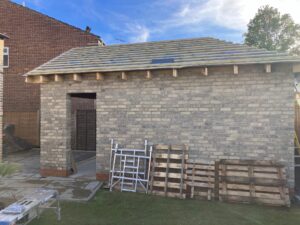
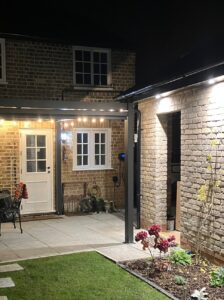
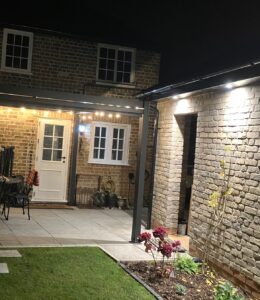
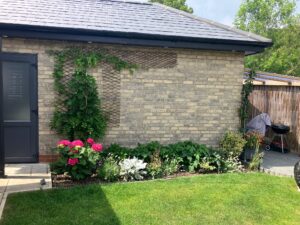
The roof was also designed to have a significant overhang as the owner had specified that they required downlighting along the garden side of the roof to provide attractive illumination for summer nights. The wiring was therefore incorporated before the roof was finished, preparing for the installation of the lights.
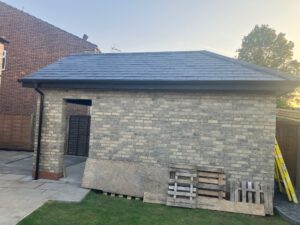
Metal straps were fitted from the roof trusses to support the gable end (again, inspected by Building Control) to ensure that the single skinned gable end would be safe, even in the strongest of winds.
Soffit boards and deep guttering in place with a single downpipe at the front of the garage to take away with clean rainwater and the roof was completed.
Drainage
Garages with pitched roofs need drainage too. The customer proposed fitting a large waterbutt to the downpipes. But considering the size of the garage and the pitch of the roof, in heavy rain there was going to be a lot of water with nowhere to go once the water butt was full. Plus the owner may use a lot of water during the summer months to water the garden, but what will they do with it in February?
Needless to say Building Control were not accepting a water butt as a solution, but this left two issues
a) There was no clean water drainage in the village, only foul water;
b) A soakaway has to be 5m metres from the property or road and the garden simply wasn’t long enough, not to mention that the high water table meant that you would hit water before you could dig down far enough to create our soakaway.
There was only one solution, which was not ideal for the environment but this was Hobson’s choice, the clean water from the guttering had to drain into the foul water drain system. This increases the amount of water in the foul water and increases the likelihood of the water company having to release untreated sewage into the rivers and lakes which no-one wants to see happen. But we have to adhere to the building regulations and this was the only solution.
To do this we had to liaise with the local water company responsible for the sewage, which was Anglian Water and apply for permission to connect the rainwater to the sewage pipe. To do this we had to submit the plans to Anglian Water with a statement from both the architect and the building inspector confirming that there was no other option. Once Anglian Water had this information they were very helpful and efficient and notified us in writing that we had consent to make this connection. This consent, is held by the customer to confirm to the next owners that the connection was both legal and certified.
Electrics
With armoured cable already laid and cabling in place for the exterior downlights, our electrician was able to connect the cabling to the consumer unit, fit two strip lights inside of the garage and two double sockets, as well as connecting the exterior lights, which illuminated the lawn and garden area beautifully. With all electrics, this was certificated and the documentation provided to building control as well as to the customer.
Finishing off
It is so important to finish off a project properly, and in this case there were several considerations which are listed below, which ensured that when we completed the job, we were not leaving any loose ends for the customer:
i) Block paving
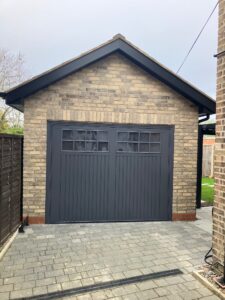
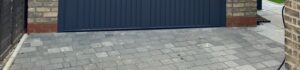
The driveway was already block paved but this was a different shape, so had to be lifted at the front and on one side of the garage. There was a lot of complex cutting to craft the block paving to seamless meld with the angled frontage of the garage door.
ii) Fence
As stated earlier this property has an extremely unusual footprint, it can be best described as being the shape of water! This left a small gap between the rear corner of the garage and the existing fence and fence post and a very unusual triangular shape behind the garage before it reached the boundary fence.
Some creativity was required to solve this issue and the customer enthusiastically welcomed the idea of a segment shaped section of block paving where they could store their logs and lawn mower etc as well as an area to extend the garden with potted plants, the end result was achieved with the same colour blocks as the drive but a different pattern and style of blocks. The end result was very pleasing. This was finished off with a perspex lean to roof to keep everything dry and is now being used a log store as well as for garden tools.
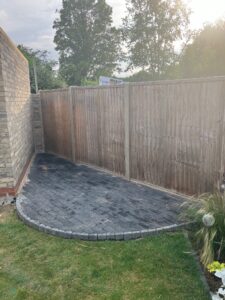
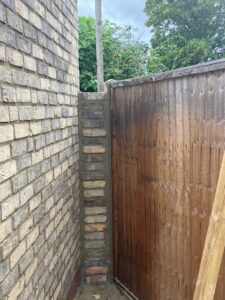
A single brick wall about 10’/30cm wide was created to fill an otherwise small gap in the boundary fence with a permanent solution.
iii) Side door
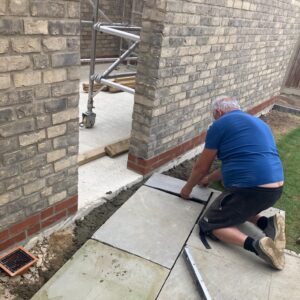
Because there was a lawn to the right side of the garage, there was no path to the new side door of the garage, so to finish off we created a path to the side door, which is also at an angle to the main patio area, but this time using sandstone slabs to match the patio. This gave a definite demarcation between the block paving of the driveway and the Indian sandstone slabs of the patio.
Doors and windows
The customer decided to get an independent window and door company to fit the garage door and the side door (there were no windows), and chose Eastern Garage doors. They came and measured the size of the opening for the up and over garage door and side door and these were ordered.
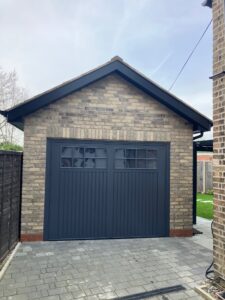
Importantly, since this was a listed building, the planning office had insisted upon a style of garage door which was in keeping with the historic nature of the house. Therefore a traditional County style of garage door was selected, which although it was a motorised up and over garage door, from the outside it looked like county-style wooden garage door. Again this was acceptable to the building inspector, who double checked that the glass in the side door was toughened.
This was the final visit for the building inspector who was both thorough and pragmatic and the completion certificate was issued and registered with the council and available for any future owner of this Grade II Listed Building.
Summary and Key Points
1. A Grade II Listed Building needs planning permission for a garage, whereas a non-listed building generally does not need planning permission for an outbuilding. Both require building control inspection.
2. Although it is possible to complete your own plans, if your initial plans are turned down, it is very difficult (without the correct architectural software and knowledge) to resubmit revised plans within the short timescale, particularly if there are queries by the planning department;
- If the first planning application is rejected, in Cambridge the resubmission is NOT free;
3. Not employing an architect may be a false economy. For a Listed Building, the garage or outbuilding must be in keeping the with the character of the main building. Greater Cambridge Construction do offer a complete Design and Build Service which includes architect, building control and structural engineers fees;
4. There are considerable hidden costs before a spade hits the ground, including architects fees, planning fees, building control fees and structural engineers fees, budget around £1,500 in total assuming there is no resubmission;
5. The structural engineer will specify which type of foundations to create and this may be a raft, where there is a high water table; vii) You may need permission from Anglian Water to connect your drainage unless you can create a soakaway;
- Bricks and roofing must be in keeping and match the style of the main building as closely as practicable;
- Electrics must be planned ahead and it is most cost effective to lay cables during the construction rather than afterwards, particularly if the armoured cable has to pass under a patio or driveway;
6. Building Control will only sign off the completed building when everything is in place including electrics, drainage, doors and windows.
Costs
Admin costs of planning application £258
Cost of architects drawings £900
Anglian Water £215
(Breakdown of costs on next page)
Breakdown of Building Costs
| Cost in £ | Percentage of total | |
| Labour | 12250 | 37.6 |
| Brickwork | 4300 | 13.2 |
| Garage Doors | 3226 | 10 |
| Roofing Materials | 2986 | 9.1 |
| Concrete/reinforcing steel | 2388 | 7.3 |
| Soffit Boards etc | 1063 | 3.3 |
| Timber | 1056 | 3.3 |
| Electrical | 960 | 2.9 |
| Aggregate | 879 | 2.7 |
| Roofing Joists | 695 | 2.1 |
| Rubbish Removal | 366 | 1.1 |
| Toilet Hire | 338 | 1.1 |
| Plant Hire | 267 | 0.8 |
| Lintels | 213 | 0.8 |
| Guttering | 134 | 0.4 |
| Structural Engineers | 700 | 2.2 |
| Building Control | 696 | 2.1 |
| Total | 32517 | 100 |
